By Chiagoziem Abosi
Edited by Bababunmi Agbebi
When news broke that Nigeria’s debt profile had grown again, many Nigerians asked the same question:
“Is the government borrowing more money just to pay old debts?”
It is a concern shared by many residents and business owners in Ikeja, where rising living costs, transport fares and operating expenses are already stretching household and business budgets.
The Federal Government has now responded to those concerns, saying the figures being circulated do not tell the full story.
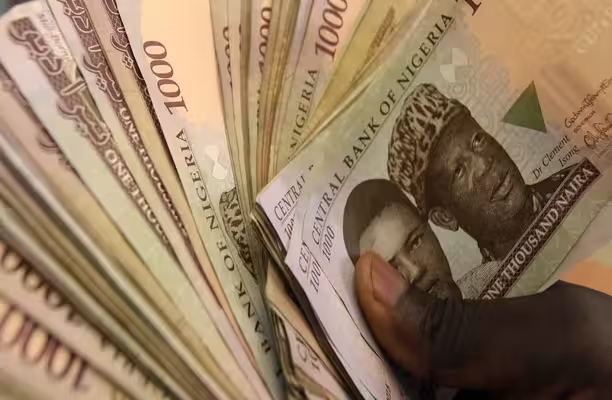
Speaking before the Senate Committee on Finance, the Minister of Finance and Coordinating Minister of the Economy, Taiwo Oyedele, dismissed claims that the Tinubu administration had borrowed about ₦80 trillion in fresh loans. According to him, a significant part of the increase in Nigeria’s debt profile is the result of exchange rate changes, the recognition of inherited liabilities and accounting adjustments, not simply new borrowing.
Oyedele explained that when the current administration took office, Nigeria’s public debt stood at about ₦75 trillion.
Since then, the naira has depreciated significantly against major foreign currencies because a large portion of Nigeria’s external debt is denominated in dollars and other foreign currencies, the value of those existing loans increased when converted to naira, even though the country did not necessarily borrow new money.
He also said the government incorporated inherited financial obligations, including previously accumulated liabilities, into the official public debt records. These accounting changes made the debt figure appear much larger than the amount of fresh borrowing undertaken by the current administration.
According to the finance minister, the answer is not entirely.
He acknowledged that governments sometimes refinance existing loans by replacing expensive debt with loans carrying lower interest rates or longer repayment periods. This practice, he said, is common around the world and should not be confused with borrowing recklessly.
“The question is not simply how much a country borrows,” Oyedele said. “The more important question is what the money is used for and whether those investments generate returns that benefit the economy.”
For many residents of Ikeja, discussions about national debt can seem distant. But government borrowing can have real effects on everyday life.
If borrowed funds are invested wisely in roads, electricity, transportation, healthcare and education, businesses could operate more efficiently and communities could benefit from better public services.
However, if debt continues to rise faster than government revenue, more money may be needed to service loans. Economists often warn that this can reduce the funds available for other public projects unless the economy grows and government revenue improves.
For business owners in Ikeja, this could influence infrastructure development, access to public services and the overall business environment over time.
The discussion has also raised questions about taxes.
While the government continues to pursue tax reforms, officials have repeatedly said the goal is to improve tax collection, simplify the tax system and expand the number of taxpayers rather than simply increase tax rates.
Still, economists note that a country’s debt position can indirectly affect inflation, investor confidence and government spending decisions, all of which eventually shape the cost of living.
Experts agree that borrowing is not unusual. Many countries borrow to finance development projects and grow their economies.
The real issue is whether borrowed funds are used efficiently enough to improve infrastructure, create jobs and generate economic growth that allows those loans to be repaid sustainably.
For residents of Ikeja, the debate is no longer just about how much Nigeria owes. It is about whether government borrowing will translate into better roads, stronger public services, more economic opportunities and a lower cost of doing business.
As conversations about Nigeria’s economy continue, many Nigerians will be watching closely to see whether today’s borrowing delivers tomorrow’s development.
Do you think government borrowing is helping Nigeria’s economy, or should the focus shift towards increasing revenue and reducing spending? Tell us what you think in the comments.