By Bababunmi Agbebi
The Lagos-Ibadan Expressway has once again become a painful reminder of the human and economic cost of inadequate emergency response, infrastructure challenges and rising living expenses.
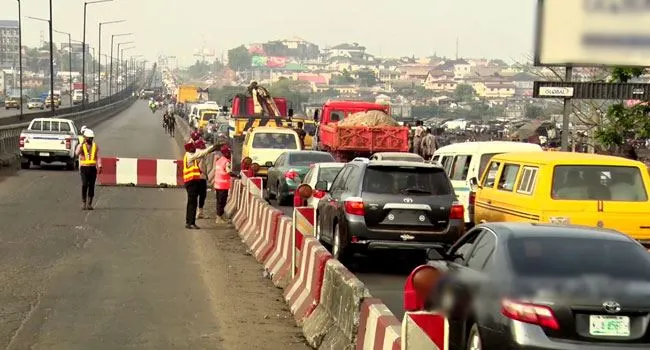
On Tuesday, September 15, a trailer conveying a container reportedly fell on the Kara Bridge, forcing the closure of the affected section and worsening the already severe congestion along the Lagos-Ibadan Expressway. The gridlock reportedly stretched beyond Berger, leaving thousands of motorists and commuters stranded for hours.
The incident came at a particularly difficult time, as motorists were already dealing with traffic disruptions caused by ongoing repairs on the Kara Bridge. Earlier reports indicated that repair work on the bridge had already triggered significant congestion along the busy Lagos-Ibadan corridor.
For many Nigerians, what should have been a normal journey home became an overnight ordeal.
Some commuters who left their offices on Tuesday reportedly spent hours trapped in traffic, with some only arriving at their destinations in the early hours of Wednesday. Others had barely any time to rest before having to prepare for another working day.
This raises an important question: at what point does a traffic emergency become a public-health and economic emergency?
The Hidden Cost of Sitting in Traffic
The immediate picture is the traffic itself, but the consequences go much further.
Vehicles stuck for hours consume fuel without making meaningful progress. At a time when petrol prices have climbed sharply, every additional hour spent idling represents another financial burden on already stretched households.
Recent reports indicate that petrol prices in parts of Lagos had risen to around ₦1,400–₦1,430 per litre following another increase in the wholesale price of petrol.
Imagine a motorist who normally spends ₦10,000 on fuel for a particular period suddenly spending significantly more because of prolonged traffic. Multiply that by thousands of vehicles trapped on the Lagos-Ibadan corridor and the economic cost becomes substantial.
There is no reliable figure yet for the total volume or value of petrol burned during this particular gridlock because that would require data on the number and types of vehicles, their fuel consumption, the duration of idling and stop-and-go movement, and other variables.
But the underlying issue is clear: time lost in traffic now comes with a much higher financial price.
When Commuting Becomes a Health Issue
There is also a human cost that cannot be measured only in naira.
People need sleep.
People need to eat.
People need to get home safely.
People need to report to work without being physically exhausted from spending an entire night on the road.
A worker who leaves the office in the evening and arrives home in the early hours of the following morning cannot reasonably be expected to function at full capacity the next morning without consequences.
This is where employers also have a role to play.
In exceptional circumstances such as major road closures, prolonged gridlock or other transport emergencies, employers should consider flexible reporting times, remote work where possible, shift adjustments or even temporary work-from-home arrangements.
Human beings are not machines.
Productivity should not be pursued at the expense of people’s safety, health and wellbeing.
The bigger question is what happens when a major obstruction occurs on one of Nigeria’s busiest transport corridors.
When a container falls, particularly on a major bridge or expressway, every minute matters.
Traffic management agencies, emergency responders, recovery operators and relevant authorities must be able to coordinate quickly to secure the area, remove obstructions, manage diversions and communicate clearly with motorists.
The public deserves to know what emergency-response mechanisms are in place for incidents of this nature and whether those mechanisms are sufficiently equipped to deal with the scale and frequency of disruptions on major highways.
The question is not simply who caused the incident?
It is also:
How quickly can the system respond when it happens?
The traffic crisis is unfolding against the backdrop of an already difficult economic environment.
Petrol prices have continued to rise, with the latest increases adding pressure to transportation costs and, by extension, household and business expenses.
For many Nigerians, the combination of expensive fuel, transportation costs, food inflation and lost working hours can feel overwhelming.
This is why the debate over Nigeria’s petroleum pricing policy remains important.
Some public figures and groups have called for changes to the current pricing framework or some form of subsidy intervention, while government officials have continued to defend the removal of the former fuel subsidy as necessary for economic reform. The Minister of Solid Minerals Development, Dele Alake, recently argued that subsidy removal was necessary to prevent deeper economic problems, while other voices have questioned whether Nigerians are receiving sufficient relief from the resulting cost pressures.
There is therefore a legitimate public debate over whether the current petroleum pricing framework provides enough protection for households and businesses during a period of high economic pressure.
Rather than simply asking whether subsidy should return exactly as it existed before, policymakers may need to examine the broader question:
What pricing and relief mechanism can keep fuel affordable without recreating the inefficiencies and fiscal problems associated with the previous subsidy regime?
That conversation deserves transparency, credible data and a clear explanation of how petroleum-sector savings and revenues are being used.
Is There a Plan to Kill Nigerians?
The frustration behind this question is understandable, but there is no established evidence that the government is deliberately trying to harm or kill Nigerians.
What Nigerians can legitimately demand, however, is accountability for policies and systems that affect their safety, health, mobility and ability to earn a living.
A government does not have to intend harm for a policy failure or emergency-response failure to produce serious consequences.
That is why the focus should be on solutions.
How quickly are fallen containers cleared?
How effectively are traffic diversions managed?
Are heavy-duty trucks properly regulated?
Are major bridges adequately maintained?
What emergency-response capacity exists along critical highways?
How can employers respond responsibly when workers are trapped in extraordinary traffic?
And perhaps most importantly, how can government reduce the economic burden created when Nigerians are forced to spend more money simply trying to get to work, return home and move around their own cities?
The Kara incident should not become another story that disappears once the traffic clears.
It should prompt a serious conversation about infrastructure maintenance, emergency response, road safety, employer flexibility and the rising cost of mobility.
People should not have to choose between getting home safely and getting to work on time.
A commuter who spends the night trapped on the road is not merely experiencing an inconvenience. That person is losing productive hours, spending additional money, sacrificing sleep and potentially putting their health at risk.
As Nigeria continues to navigate difficult economic reforms, the question of how to cushion citizens from the impact of those reforms cannot be ignored.
Whether the answer is a redesigned subsidy, targeted transport support, lower taxes, improved public transportation, better fuel pricing transparency or another mechanism, the objective should be the same: an economy that reforms without making ordinary Nigerians bear an unsustainable human cost.
The Kara gridlock is therefore more than a traffic story.
It is a question about the value placed on people’s time, safety, health and livelihoods.
And Nigerians deserve answers.
Recommended posts:
 Fuel Price Fluctuation Since The Return Of Democracy In Nigeria
 “We Nigerians are our own problem”: Daniel Regha, others blast petrol stations for the sudden price of fuel
 Nigerians which way? : Fuel increases to N617 per litre
 Fuel scarcity persists as NNPC & Oil companies trade blames over contaminated fuel