
By Bababunmi Agbebi
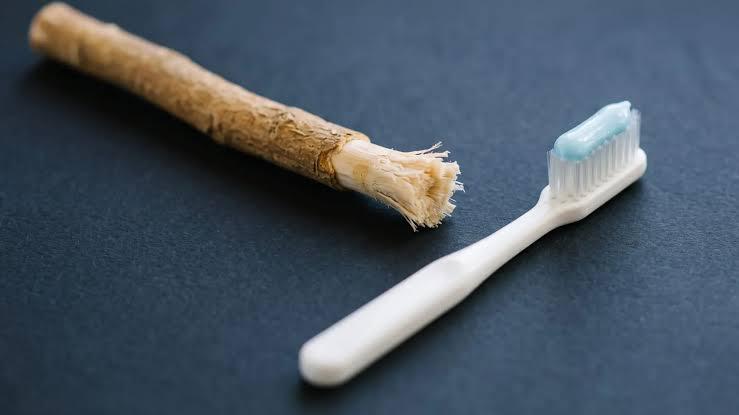
For generations, the chewing stick has been a familiar part of oral hygiene in Nigerian homes. From neem sticks to Salvadora persica, commonly known as miswak, many Nigerians have relied on these natural tools to clean their teeth and maintain fresh breath.
But with toothbrushes and fluoride toothpaste now dominating bathroom shelves, one question remains: which is actually better for your teeth, the traditional chewing stick or the modern toothbrush?
The answer, according to available research, is not as simple as saying one is good and the other is bad.
Scientific studies have found that certain chewing sticks, particularly Salvadora persica, can effectively reduce dental plaque and gingivitis.
A systematic review and meta-analysis published in the Journal of Ethnopharmacology found that Salvadora persica chewing sticks were comparable to standard toothbrushes in controlling plaque and showed potential benefits against gingivitis.
Another systematic review found that miswak could reduce plaque and gingivitis to levels comparable with toothbrushes when used alone. The researchers also reported that using miswak alongside conventional toothbrushing could provide additional benefits for periodontal health, although they noted limitations in the available evidence.
So, the idea that chewing sticks are simply an outdated or ineffective method is not supported by the evidence.
The biggest difference is not necessarily the brush itself; it is the fluoride toothpaste commonly used with it.
Fluoride helps strengthen tooth enamel and can prevent and even help reverse early stages of tooth decay. The American Dental Association recommends brushing twice a day with fluoride toothpaste for at least two minutes.
A chewing stick can mechanically remove food debris and plaque, but a traditional stick does not automatically provide the same established fluoride exposure as brushing with fluoride toothpaste.
That distinction matters because tooth decay is one of the major oral-health concerns that daily hygiene is intended to prevent.
Interestingly, Nigeria supports the importance of how often people clean their teeth, rather than simply focusing on the cleaning tool.
A recent systematic review and meta-analysis of oral hygiene practices and dental caries in Nigeria found that brushing at least twice daily was associated with reduced dental caries. Toothbrush and toothpaste were the most commonly reported cleaning tools, although chewing sticks and other traditional methods were also used. The study did not find the type of cleaning tool itself to be significantly associated with dental caries risk.
In other words, consistency matters.
Using a chewing stick once in a while is unlikely to compensate for poor oral hygiene habits, just as owning an expensive toothbrush does not guarantee healthy teeth if it is rarely used.
So, Which One Is Better?
If the question is chewing stick versus toothbrush alone, research suggests that a properly used chewing stick can be a legitimate oral-cleaning tool.
But if the question is chewing stick versus a soft-bristled toothbrush used twice daily with fluoride toothpaste, the toothbrush-and-fluoride combination has the stronger evidence for routine cavity prevention.
The American Dental Association recommends brushing twice daily for two minutes with fluoride toothpaste and cleaning between the teeth daily.
That does not mean Nigerians who use chewing sticks must abandon them.
For someone who prefers chewing sticks, they can be incorporated into an oral hygiene routine, provided they are used properly and gently.
Some people may also choose to use a chewing stick during the day and brush with fluoride toothpaste morning and night.
The important thing is to avoid aggressive scrubbing. Excessive force, whether with a toothbrush or chewing stick, can irritate the gums and potentially contribute to dental problems.
And regardless of the cleaning method, the spaces between teeth should not be ignored.
Ultimately, the real winner may not be the toothbrush or chewing stick.
It is good oral hygiene, practiced consistently.
Brush or clean your teeth properly twice a day, use fluoride toothpaste when brushing, clean between your teeth, limit frequent sugary snacks and drinks, and see a dental professional when you have persistent pain, bleeding gums or other concerns.
Because when it comes to your teeth, tradition and modern dentistry do not necessarily have to compete, the smartest approach is the one that combines proven science with habits you can maintain consistently.