By Bababunmi Agbebi
Edited by Ezennia Uche
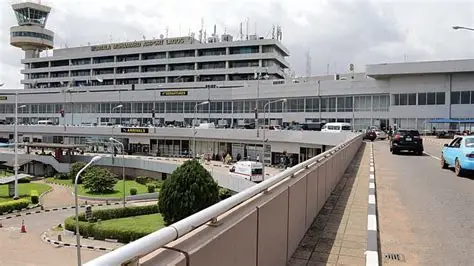
Located in Ikeja, a bustling commercial and residential district of Lagos State, Nigeria, Murtala Muhammed International Airport (MMIA) stands today as the country’s most important aviation gateway. Beyond its function as a transportation hub, the airport has been a powerful driver of spatial transformation, economic vibrancy, land-use changes and demographic shifts in Ikeja and the surrounding metropolitan fringe.
The origins of what is now MMIA trace back to World War II, when the need for air infrastructure in West Africa gave birth to a modest airfield in Lagos. It became the operational base for the West African Airways Corporation (WAAC) shortly after the war, signaling Ikeja’s early connection to air transport.
Originally known as “Lagos Airport,” the facility was renamed in 1976 in honour of the then-Head of State, Murtala Muhammed, following his assassination. This change coincided with ambitious plans to upgrade the airport into a modern international terminal. By March 15, 1979, a new international terminal modelled on Amsterdam’s Schiphol Airport was inaugurated, marking Nigeria’s intention to position Lagos as a pan-African aviation hub.
MMIA’s subsequent decades have been characterised by periods of expansion and renovation, reflective of Nigeria’s broader economic and political cycles. By the early 2000s, the domestic terminal was rebuilt after a devastating fire, and the airport steadily grew in passenger and cargo traffic.
More recent efforts include the commissioning of a state-of-the-art International Terminal 2 in 2022, designed to boost capacity to about 14 million passengers annually. This expansion — driven by bilateral air service agreements, improved airline connectivity, and private sector participation underscores the airport’s strategic role in Nigeria’s global integration.
However, legacy infrastructure such as Terminal 1 saw prolonged neglect, prompting extensive renovation plans approved in 2025 with funding of over ₦700 billion, including reconstruction, airfield lighting improvements, apron expansion, and access road upgrades.
Ikeja Transformed: Economic and Spatial Impact of the Airport
1. Economic Magnet and Growth Pole
The airport’s evolution has fundamentally reshaped the economy of Ikeja. A 2017 spatial analysis confirms that within a five-kilometre radius of the airport, the local economy became intensely concentrated with air transport, logistics, freight services, hotels, retail, and supporting industries clustering near the facility. The airport effectively became a growth pole that pulled economic activity toward its surrounds.
The flourishing of cargo handlers, freight forwarders, and transit services has generated thousands of jobs. From multinational carriers to Nigerian domestic airlines, MMIA’s operations create direct and indirect employment from ground handling to customs operations, hospitality to transportation. These jobs have underpinned Ikeja’s transformation from a quiet residential area into one of Lagos State’s busiest commercial hubs.
2. Real-Estate Dynamics and Urban Development
As passenger and cargo traffic expanded, demand for proximate real estate. commercial offices, hotels, warehouses, and residential units surged. Developers and investors increasingly see Ikeja as attractive not only because of proximity to Lagos Island or the Lekki corridor but because of the airport’s connectivity and growth potential. This real-estate premium has contributed to rising property values and densification in districts such as Ajao Estate, Ojodu, and Agege.
3. Infrastructure and Public Services
MMIA’s presence has also necessitated extensive transport and utility infrastructure. Access roads, bridges, power distribution, and public services have expanded to accommodate both airport activities and the growing resident population. Although Lagos’s infrastructural challenges persist, the airport’s influence has encouraged federal and state investments that benefit Ikeja broadly.
Despite its strategic value, the airport and its impact on Ikeja have not been without challenges:
- Infrastructure Strain: Old terminals and delayed maintenance have led to congested facilities and outdated systems, drawing criticism and fueling major reconstruction projects.
- Security and Efficiency: MMIA continues to grapple with issues of security bottlenecks and operational inefficiencies, problems that threaten user experience and investor confidence.
As Africa’s air traffic grows, Lagos and by extension Ikeja is poised to capture a larger share of regional connectivity. Being ranked among Africa’s top-ten busiest airports has already boosted airport and local property demand.
Plans for comprehensive modernization, improved cargo handling capacities, and strategic public-private partnerships signal a renewed focus on unlocking MMIA’s full potential. The ongoing redevelopment will not only enhance Nigeria’s aviation competitiveness but also consolidate Ikeja’s role as a dynamic economic node within West Africa.
From humble wartime origins to one of Africa’s most significant aviation gateways, the Murtala Muhammed International Airport has long been more than an air transit point. It has catalysed economic transformation, reshaped urban geography, and driven socio-commercial change in Ikeja and greater Lagos. As infrastructure upgrades gather pace and capacity expands, the airport’s influence on the city’s trajectory will only deepen, affirming its position at the heart of Lagos’s continual reinvention.