By Bababunmi Agbebi
Edited by Ezennia Uche
Fifty years ago, on a quiet Friday morning in February 1976, Nigeria stood still.
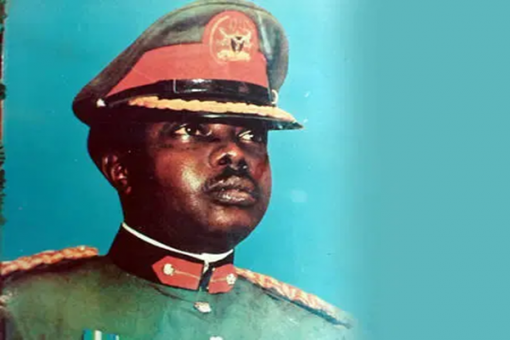
Bullets shattered more than the glass of a black Mercedes-Benz in Ikoyi. They pierced the fragile hope of a young nation searching desperately for direction. In a matter of seconds, General Murtala Ramat Muhammed, Head of State, reformer, firebrand, symbol of urgency FELL. And with him fell a generation’s audacious belief that change could arrive not gradually, not timidly, but boldly and immediately.
Half a century later, his name still reverberates like a drumbeat in the Nigerian consciousness.
Murtala Muhammed was not a perfect man. History rarely gives us perfect leaders. But it gave Nigeria a man of fierce clarity, a leader who moved with uncommon speed and spoke with startling candor. In an era when bureaucracy crept and corruption festered, he cut through stagnation like a storm wind through dry grass.
He did not whisper reform. He declared it.
Within months of assuming office in 1975, he shook the foundations of a complacent system. Thousands of corrupt or ineffective officials were dismissed in a sweeping purge that sent shockwaves through the civil service. Ministries trembled. The message was unmistakable: public office was a sacred trust, not a personal inheritance.
To many, he was severe. To others, reckless. But to millions, he was necessary.
His voice on the African stage carried a moral authority far beyond Nigeria’s borders. He stood unapologetically against colonialism and apartheid, offering unflinching support to liberation movements across Southern Africa. In international halls where diplomacy often softened conviction, Murtala’s words retained their steel. He believed Nigeria was not meant to shrink, it was meant to lead.
And lead he did, even if only for 200 days.
There was something electric about his presidency. Markets buzzed with political conversations. Radio broadcasts felt urgent. Ordinary Nigerians felt seen, perhaps for the first time in years by a leader who seemed impatient with mediocrity. He embodied motion. He embodied will.
Then came February 13.
An attempted coup. Chaos on the streets of Lagos. Confusion in homes and barracks alike. By the time the dust settled, the man who had embodied momentum lay lifeless. He was only 37.
Thirty-seven.
At an age when many are still discovering themselves, Murtala Muhammed had already inscribed his name into the marble of history. His assassination was not just a political act; it was a national trauma. It forced Nigeria to confront a haunting question: Why does promise so often meet violence in its youth?
Fifty years later, his legacy remains both inspiration and indictment.
Inspiration, because he reminds us that leadership can be bold, that governance can be decisive, that patriotism can be fierce and unembarrassed. He reminds us that systems are not immovable; they can be shaken, even rebuilt, by courage and conviction.
Indictment. because the dreams he ignited remain unfinished. The corruption he challenged persists in new forms. The urgency he modeled has too often given way to caution. The unity he sought still feels fragile.
Yet perhaps that is precisely why his memory endures.
Murtala Muhammed represents possibility, the idea that Nigeria, vast and complicated, can rise above its contradictions. He symbolizes a moment when hope did not feel naive, when leadership did not feel ornamental, when action spoke louder than promises.
The airport that bears his name in Lagos welcomes millions each year. Travelers rush through its terminals, often unaware that it honors a man who once dared to accelerate a nation. His portrait hangs in institutions. His story appears in textbooks. But beyond the monuments and memorials lives something deeper: a collective memory of urgency.
Fifty years is a long time.
Few children born after his death are now grandparents. Governments have come and gone. Policies have risen and fallen. But history still circles back to that young general whose tenure was brief but blazing.
Perhaps remembrance is not merely about nostalgia. Perhaps it is about responsibility.
To remember Murtala Muhammed is to ask ourselves uncomfortable questions. What do we do with the courage of those who came before us? Do we reduce them to statues and street names, or do we wrestle with the standards they set? Do we mourn what was lost, or do we complete what was started?
On this fiftieth anniversary, Nigeria does more than recall an assassination. It recalls a heartbeat, fast, urgent, uncompromising.
He was not given decades. He was given months. And in those months, he reminded a nation of its strength.
The bullets that silenced him could not silence the idea he represented: that leadership demands bravery; that patriotism requires sacrifice; that nations, like people, must sometimes be jolted awake.
Fifty years later, the echo remains.
And perhaps, if we listen closely, it still calls us forward.