By Bababunmi Agbebi
Edited by Ezennia Uche
In the heart of Nigeria’s commercial capital, two prominent religious structures stand within walking distance of the seat of power. The Chapel of Christ Our Light and the Ikeja Central Mosque are more than architectural statements of faith. They are physical symbols of Lagos State’s attempt to balance religion, governance, and public life in one of Africa’s most religiously vibrant and diverse societies.
Their presence in Alausa, home to the Lagos State Secretariat and the Governor’s Office offers a compelling lens through which to examine how political leadership in Lagos has navigated religious pluralism, symbolism, and statecraft.
Lagos is a city of paradoxes: deeply spiritual yet cosmopolitan, traditional yet modern, intensely competitive yet communally interwoven. Christianity and Islam dominate its religious landscape, often coexisting within families, neighborhoods, and workplaces.
Since Nigeria’s return to democratic rule in 1999, political leaders in Lagos have been acutely aware of the delicate religious balance that underpins social stability. Public officeholders routinely emphasize inclusion, aware that perceived favoritism toward one religious group could trigger political backlash or social tension.
It was within this context that the Lagos State Government oversaw the development of two major worship centers in Alausa. The decision was not merely logistical providing civil servants with places of worship, it was deeply symbolic.
The Chapel of Christ Our Light: Faith Within the Seat of Power
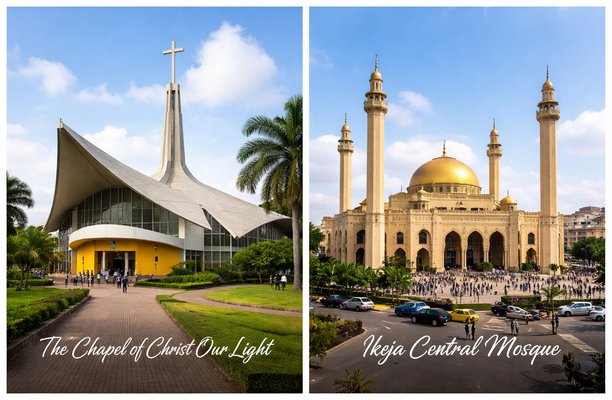
The Chapel of Christ Our Light was conceived as an interdenominational Christian worship center serving government officials, civil servants, and visitors within the state secretariat complex.
Its architecture is both modern and dignified, reflecting Lagos’ aspiration toward global relevance while remaining rooted in local identity. Strategically located near the corridors of executive authority, the chapel underscores the role of faith in the lives of public servants who govern millions.
Beyond Sunday services and midweek fellowships, the chapel has hosted state events, thanksgiving services, and official ceremonies. It has become part of the ritual rhythm of governance, where political milestones intersect with spiritual reflection.
The Ikeja Central Mosque: A Mirror of Inclusion
Adjacent to the chapel stands the Ikeja Central Mosque, serving the Muslim community within the same administrative district.
The mosque’s presence is critical to understanding the state’s broader approach. Rather than privileging one faith, the government facilitated parallel religious landmarks, an architectural expression of equilibrium.
The mosque functions not only as a space for daily prayers but also as a gathering point during major Islamic observances. Like the chapel, it plays a role in official and semi-official state moments, reinforcing the idea that governance in Lagos acknowledges and accommodates religious identity.
In political terms, the pairing of the mosque and chapel has often been cited as evidence of Lagos’ pragmatic pluralism, an effort to ensure that public symbolism mirrors the demographic and spiritual realities of its population.
The decision to site both structures within the same governmental precinct sends a subtle but powerful message: religious coexistence is not peripheral to governance in Lagos,it is embedded within it.
This is particularly significant in Nigeria, where religious tensions in other regions have at times escalated into conflict. Lagos, by contrast, has cultivated a reputation for religious accommodation. The twin landmarks reinforce this narrative visually and institutionally.
They stand as a reminder that political stability in Lagos has often depended on symbolic gestures as much as on policy decisions.
The Lagos model raises broader questions about secularism and state neutrality. Nigeria’s constitution prohibits the adoption of a state religion, yet religion remains deeply intertwined with political culture.
By facilitating both the chapel and the mosque, Lagos State appears to have chosen a path of balanced engagement rather than strict separation. It neither excludes religion from public life nor elevates one faith above another.
No public project is immune to scrutiny. Questions have periodically arisen about cost, funding sources, and the optics of state involvement in religious infrastructure. Such debates are healthy in a democracy, particularly in a state as politically vibrant as Lagos.
Yet the enduring presence of both landmarks suggests that their significance transcends controversy. They have become woven into the institutional memory of Alausa, a physical testament to Lagos’ effort to model peaceful religious coexistence at the administrative heart of the state.
The story of the Chapel of Christ Our Light and the Ikeja Central Mosque is ultimately a story about governance in a plural society.
In placing these two landmarks side by side, Lagos State crafted more than worship centers, it constructed a visual narrative of balance. The buildings speak to an understanding that in a city where faith shapes identity, politics, and community life, inclusive symbolism is not optional; it is foundational.
As Lagos continues to evolve as a megacity and economic powerhouse, its twin religious landmarks remain quiet but powerful reminders that the management of diversity, religious and otherwise is central to the art of governance.