
Edited by Bababummi Agbebi
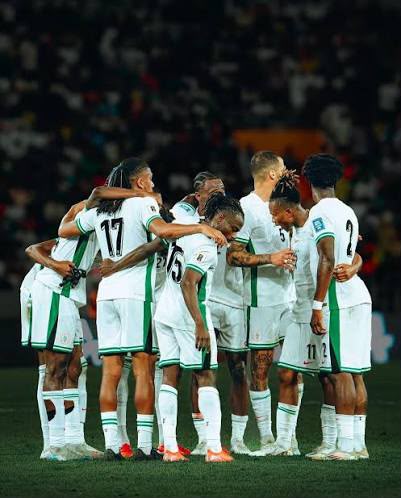
The Super Eagles have once again found themselves facing difficult questions after a disappointing 3-0 defeat to Guinea-Bissau in their 2027 Africa Cup of Nations qualifying campaign.Nigeria entered the Group L encounter looking to build on a 2-1 comeback victory over Madagascar in their opening match. Instead, the Super Eagles produced a performance that exposed familiar weaknesses and left their qualification hopes under unnecessary pressure.Franculino Djú gave Guinea-Bissau the lead in the 15th minute before Mama Baldé doubled the advantage in the second half. Álvaro Djaló completed the rout in stoppage time, giving the hosts a convincing victory.The defeat is particularly concerning because of how Nigeria struggled to impose itself on the game.Losing away from home is not unusual in African football, but the manner of the defeat raises bigger questions.
Guinea-Bissau showed greater intensity and purpose from the opening stages, while Nigeria struggled to consistently match the hosts’ aggression. Super Eagles coach Éric Chelle himself acknowledged after the game that Guinea-Bissau were more aggressive and that Nigeria struggled to find solutions.
That admission is significant because it points beyond individual mistakes.
Nigeria appeared vulnerable whenever Guinea-Bissau attacked with pace, and the hosts repeatedly found spaces around the Nigerian defence. Both the second and third goals demonstrated how easily the Nigerian defensive structure could be exposed.
The Super Eagles did have opportunities. Nigeria finished with 55 per cent possession and 12 shots, compared with Guinea-Bissau’s 12, but the hosts recorded seven shots on target against Nigeria’s five.
The statistics therefore do not suggest that Nigeria were completely overrun. Rather, they underline a more troubling problem: possession and opportunities meant little when the team could not convert them into control or goals.
Perhaps the biggest concern for Nigerian football supporters is the feeling of déjà vu.
The Super Eagles have experienced several qualification campaigns in recent years where early setbacks have created unnecessary pressure. The failure to qualify for the 2026 FIFA World Cup remains fresh, making this latest defeat particularly uncomfortable.
Even more striking is that Guinea-Bissau have now defeated Nigeria twice in AFCON qualifying, having previously beaten the Super Eagles 1-0 in Abuja during the 2023 qualifying campaign.
That history makes the latest result difficult to dismiss as simply an off day.
The recurring question is whether Nigeria are consistently doing enough before and during qualifying matches to prevent these setbacks.
A team with Nigeria’s depth and international experience should be capable of responding when opponents disrupt its preferred style of play. Yet against Guinea-Bissau, the Super Eagles struggled to find answers even after falling behind.
The three goals also raise questions about Nigeria’s defensive organisation.
Guinea-Bissau repeatedly found opportunities to attack the spaces around the Nigerian backline. The first goal came after Djú cut inside and found the bottom corner, while Baldé exploited space to score the second. Djaló then added a third after Nigeria pushed forward in search of a consolation goal.
These moments point to a team that was not sufficiently compact or alert defensively.
For a side trying to qualify from a group where only one team can secure the available qualification place, such lapses can prove costly.
Despite the heavy defeat, Nigeria’s qualification hopes are not over.
The Super Eagles currently have three points from two matches, while Guinea-Bissau have six. Madagascar and Tanzania have one point each after their 1-1 draw.
However, the structure of the group leaves Nigeria with little room for further mistakes. Tanzania are co-hosts of the 2027 AFCON and are therefore already assured of participation, meaning the available qualification place in this group becomes particularly important for Nigeria, Guinea-Bissau and Madagascar.
Nigeria’s next qualifying assignments are against Tanzania, with the Super Eagles hosting the Taifa Stars in Uyo on November 13 before travelling to Dar es Salaam four days later.
Those two matches could significantly reshape the group.
The immediate objective for Chelle and his players should therefore be to restore consistency, improve defensive organisation and demonstrate that the Guinea-Bissau defeat was a setback rather than the beginning of another qualification crisis.
The concern is not simply whether Nigeria can recover three points in the next match.
It is whether the team can develop the consistency required to qualify comfortably and compete against opponents who are increasingly willing to challenge Nigeria without intimidation.
Nigeria cannot afford to repeatedly enter important qualifying matches, concede control early and then spend the rest of the game trying to recover. That approach places enormous pressure on the players and makes qualification unnecessarily difficult.
The road to the 2027 AFCON is still open, but the margin for error has narrowed.
For the Super Eagles, the next challenge is not simply winning the next match. It is demonstrating that the team has learned from another painful setback and can finally break the cycle of inconsistent performances that has followed them through recent qualification campaigns.
The response to this defeat will say much more about Nigeria’s qualification prospects than the defeat itself.